Tuesday, 10 September 2019

Bottoms up! a 5e / GLOG bolt-on mechanic for potion brewing

"I can teach you how to bewitch the mind and ensnare the senses. I can tell you how to bottle fame, brew glory, and even put a stopper in death."
- J.K. Rowling, Harry Potter and the Sorcerer's Stone

Who needs a better reason than Snape's speach to learn potion brewing? This is a bolt-on system that any class can make use of. Fit for D&D 5th edition and for the GLOG.

Our party barbarian has been spending time with the local potion brewer to learn the craft. Although I use Goblin Punch's 100 potion recipes, ad-libbing the brewing process costs me a bit of time every session. So if I just hammer out a quick system, that should me save time in the long run...

To your health!

Lab work 101. Much still to learn.

TOIL AND TROUBLE

To become a potion brewer, you need to learn the Alchemy skill (a couple of sessions of work with a friendly alchemist in downtime gets you basic proficiency). Then, it's time to experiment and trade so you can learn new recipes. These come in 5 categories: common - uncommon - rare - very rare - legendary.
  • Once you learn Alchemy, you know how to make 3 Common potion recipes.
  • Recipes cost half their store value to create.
  • Very Rare and Legendary potions also cost a special component to create; you can flavor other potions with components if you like, but I just assume those are part of the base cost.
  • Buying a new recipe costs the same as its store value.
  • To brew any potion, you need a laboratory outfitted to certain specifications and you need to be of a minimum level yourself.

Identifying potions in Goblin Punch's potion system is a matter of keeping records: each has a distinct look, taste and effect for taking a sip. Anyone can work out that system with time and a notebook.
Trained potion makers can automatically identify potions they know the recipe to.

Using skill checks in your game? You can roll with advantage (2d20, take the best roll) to identify any potion type you could already brew, or roll an ordinary check to identify potions that are still too difficult for you. (Example: in 5e, a 5th level bard with alchemy training could brew and easily identify common, uncommon and rare recipes.)


5e prices and criteria:
D&D 5e doesn't formally put a price on magic items, but it's handy to know how much they're worth anyway. For instance, when you want to trade in a magic staff to buy yourself a bishopric. I'm using the lower end of these item prices, but adjusted the higher levels because I don't see anyone plonking down 50,000 gp for a single potion of youth, even though it de-ages you 3d6 years and gives you 1000 XP. Then again, maybe I'm just not used to high level play. 

potion type
5e level
lab size
sell potion
create potion
common
1
100 gp
50 gp
25 gp
uncommon
3
250 gp
100 gp
50 gp
rare
5
500 gp
500 gp
250 gp
very rare
7
1000 gp
1000 gp
500 gp
legendary
9
5000 gp
10000 gp
5000 gp


GLOG prices and criteria:
The GLOG has less levels and lower XP thresholds than 5e D&D, so using XP for gp, I expect players to have less wealth to throw around. These prices are aimed at having the lab be a serious investment, but not crippling.

potion type
GLOG level
lab size
sell potion
create potion
common
1
100 gp
50 gp
25 gp
uncommon
2
200 gp
100 gp
50 gp
rare
3
400 gp
200 gp
100 gp
very rare
4
700 gp
400 gp
200 gp
legendary
5
1000 gp
5000 gp
2500 gp


Basic supplies


POTION RECIPES

This has been taken wholesale from Goblin Punch; there's just no improving on his format with brief rules and sensory clues! Any edits and mistakes are mine.

common recipes
comprehension, false life, hate, healing 2d4+2, heroism, love, sovereign grease, ventriloquism

uncommon recipes
anchoring, bottle imp (blue, gold, green, grey, purple, red), bounty, breathlessness, burrow, clairvoyance, darkvision, energy resistance, fire breath, fleeting journey, giant size, glibness, gold, grandeur, healing 4d4+4, hide from animals, hide from undead, invincibility, iron skin, levitation, magic weapon, mapping, mirror image, purge poisons, reverse gravity, seal soul, shrink, sound bubble, speak with beasts, speak with birds, speak with crawling things, speak with fish, speak with plants, spider climb, suggestion, tongues, transposition, water breathing, zombie blood

rare recipes
alternate self, deep sleep, ethereality, flight, gaseous form, green slime, haste, healing 8d4+8, invisibility, mutate spell, mutation, nondetection, poison (DMG), raise dead, sovereign glue, speak with dead, speak with metal, the great gambler, the hero, the poltergeist, the scoundrel, transformation: bees, transformation: rat, transformation: salmon, transformation: seagull, universal solvent, water walk

very rare recipes
cloudkill, duo-dimensionality, exit, healing 10d4+20, liquid boat, petrification, polymorph, random teleport, recapture spell, simulacrum d6m, spell ward until sleep, transformation: troll, true seeing, void metal, void wood, X-rays

legendary recipes
lycanthropy, sovereign acid, time hack, time skip, youth


POTION EFFECTS
Originally by Goblin Punch, tweaks in red to up some durations or effects for 5e by myself.

>> GOOGLE DOC <<

Sunday, 8 September 2019

Spending your loot, part 4: labs, libraries and shrines

My house rules are costing me prep time and that will not do. I give you quicky rules for laboratories, libraries and shrines that allow players to invest in learning new spells.

Spellcasters in Belswick have to buy or find new spells in stead of getting them for free when they level, which means that I have to look ahead and drop spellbooks every now and again. Tedious work. Much easier to have them sort this out themselves. Rather than revoke, I'll patch and try to tie this into the rules for characters growing rich off of dungeoneering.

SHRINES, LABS AND LIBRARIES

Standing house rule: all my spellcasters except nature types have to earn their spells, they don't get new spells whenever they level. By collecting tools of the trade, they can now outfit a workshop to experiment and learn new tricks.

Shrines are for divine casters (clerics, some bards), libraries are for arcane casters (some bards, sorcerers, warlocks and wizards) and laboratories are for potion brewers. Each type of workspace has a couple of suggested items to stock it with - use this as a starting point and get your player's input on what they'd like to furnish their workspace with.

As a bonus, most of this stuff is fragile or hard to move, meaning you need a place to store it - save up for that home base!

LABORATORY

Includes a basic workshp with glasswork and supplies, but also recipe books and rare components.

Gain two potion recipes every time you gain a level. You can benefit from only one laboratory each time you level up. Must have the ability to brew potions (potionmaking skill) to benefit from a lab.
  • common laboratory: 100 gp, common potion recipes
  • uncommon laboratory: 250 gp, uncommon potion recipes
  • rare laboratory: 500 gp, rare potion recipes
  • very rare laboratory: 1000 gp, very rare potion recipes 
  • legendary laboratory: 2000 gp, legendary potion recipes

From Life of the Party - Realities of an RPGer


Lesser books
Value is 25-50 gp, depending on the state of the copy, quality of notes in the margins etc.
  • Sprinkwurtle's Arcanofauna - wildly speculative book on cryptids
  • The Hermetic and Alchemical Writings of Aureolus Philippus Theophrastus Bombastus von Hohenheim - self-aggrandizing pamflet on the claimed workings of Paracelsus the Great
  • The Sage's Garden - primer on herbalism

Greater books
Value is 50-100 gp, depending on state of the copy, missing pages etc.
  • A Discourse of Fire and Salt - on refining alchemical components
  • Essences and Transfusions - on distillation and transferal of properties
  • The Book of Smokeless Fire - Almad poems on alchemical recipes
  • The Sorcerer's Stone - on spiritual and bodily ascension
  • The Transmutation of Metals - on chemical processes
  • The Triumphal Chariot of Antimony - on substances acidic, caustic and hypergolic
  • The Wise-Man's Crown - methods of distillation and divination
  • Transformatica - alterations of the physical body

Equipment


  • Basic alchemist's supplies - 50 gp
  • Basic herbalism kit - 5gp
  • Basic poisoner's kit - 50 gp
  • Apothecary drawer - 15 gp
  • Brazier - 20 gp
  • Glassware - 10 gp
  • Hourglass - 15 gp
  • Mortar and pestle - 10 gp
  • Notebook - 5 gp
  • Herb garden - 25 gp
  • Tripod and cauldron - 20 gp

Weird - 250gp
Organs of magical creatures or shoots of magic plants, such as but not limited to:
  • Vial of basilisk's blood
  • Bundle of manticore spikes
  • Beaker of green slime
  • Mandrake beds
  • Lotus hothouse
  • Cage with magical beast - cost and value to library is equal to half MM XP value
    • other alchemists bought: blight, crawling claw, darkmantle, doppelganger, fungi, ghoul, homunculus (2x value), mephit, pixie, fire snake, slaad tadpole, sprite,
    • 2x cost for extra containment: (the "you fool" catalog) banshee, basilisk, blink dog, cockatrice, chimera, cloaker, couatl, displacer beast, dragon wyrmling, ghost, gibbering mouther, griffon, green or sea hag, hippogriff, intellect devourer, manticore, nothic, ooze, phase spider, rust monster, succubus/incubus, troll in jar of acid, unicorn, water weird, will-o-wisp

LIBRARY

Includes reference works, permanent components to meditate with, weird items to experiment with, and so on. A transmuter might also look at laboratory equipment for their alchemical studies.

Gain two free spells for your spellbook each time you gain a level in bard, sorcerer, warlock or wizard. You can benefit from only one library each time you level up. Numbers are chosen so that they are cheaper than buying two spells from a wizard college (50 gp/spell level).
  • bookshelf: 100 gp, level 1 spell (GLOG: school spells 1-6)
  • small library: 250 gp, level 1-2 spells (GLOG: school spells 1-8)
  • library: 500 gp, level 1-3 spells (GLOG: school spells 1-10)
  • extensive library: 1000 gp, level 1-4 spells (GLOG: N/A)
  • major library: 2000 gp, level 1-5 spells (GLOG: all school spells except Emblems)
  • immense library: 5000 gp, level 1-6 spells (GLOG: 1 Emblem spell per level)
  • arcane spells of level 7-9 are forbidden lore in Belswick. Outfitting a forbidden library to study these spells would take 50,000 gp at least. If you're not playing with the top levels cut off, go with 6000, 7000, 8000 gp for spell levels 7, 8 and 9. 
By Redjarojam


Lesser books 
Value is 25 - 50gp, depending on the state of the copy, quality of notes in the margins etc.
  • Arcane Resonances - on amulets, perfumes and tattoos to enhance spellcasting
  • Galen's Anatomy - early text about the body's organs
  • Kriptografi - ciphers and decryption methods
  • Lorebook of Pigments - ingredients of magical inks
  • The Arcane Consequence - on the morality of magic
  • The Complete Draconic Lexicon - dictionary for High Xarsic with detailed etymology


Greater books
Value is 50 - 100 gp, depending on state of the copy, missing pages etc.
  • De Humani Corporis Fabrica - identifying and altering the body's energy flows
  • Dictionary of Lamtis Vahl - a rearranging matrix of sublinguistics to match every tongue
  • Legends of Sepulchral and Perpetual Lamps - on evocation and dismissal of spirits
  • Mage Illeswyte’s History Arcanum - facts of wizardry’s origins and development
  • Principles of Higher Art - papers on theoretical aspects of arcane magic
  • Spellcrafting journal - personal diary of meticulous wizard attempting to create new spells
  • The Ancient Mysteries of the Alabaster Tower - details a forgotten magical tradition
  • The Exact and Subtle Art - on astrology and the paths of heavenly bodies
  • The Intermingling of the Great Lords - on children begotten by a mortal and a devil
  • The Origin of Magic - myths that explain how magic came into the world
  • The Roll of Spells - tiny, precise script lists the names and effects of thousands of spells

Proscribed books
Value is 200 gp. These books are rare and dangerous to own.
  • A Plea for Necromancy - addresses prejudices against necromancy
  • Carved tablet of gray stone - ancient practices and instructions for binding outsiders
  • Lord Ilgraine's Last Command - tale of a knight and his beguiling ways
  • The Courtier's Gift - on weaving illusions
  • The Darke behind the Starres - work on contacting and conjuring eternal spirits
  • The Iron Codex - black iron sheets strung together with chains - diagrams for planar travel
  • The Lost Divinities - speculation on deceased or vanished deities
  • Through the Gate of the Silver Key - outlines a deeply troubling cosmology

Equipment

To study or just to decorate your library with. Prices range up to 5x higher for ornate versions made out of rare materials. 
  • Astrolabe - 40-200 gp
  • Globe (very incomplete) - 60-300 gp
  • Gnomon (sundial) - 10-50 gp
  • Labelled skeleton - 70-350 gp
  • Sextant - 25-125 gp
  • Stuffed alligator - 30-150 gp
  • Telescope - 500-2500 gp (the Church does not like you spying on the angels above)
  • Telluric Arm - 700-3500 gp - uses vibrations in the earth to sketch maps of what lies beneath

Spell components
Components like these are not consumed during casting and may be used to get insight into the workings of magic. (GLOG: different spell system, no costly components for most spells. Keep the Clone vat and Scrying vessel, at 500 gp each.)
  • Chromatic Orb - diamond - 50gp
  • Clairvoyance - glass sphere or jeweled horn - 100gp
  • Clone - sealable incubation vessel - 2000gp (proscribed spell)
  • Gate - perfect diamond - 5000gp (proscribed spell)
  • Identify - pearl - 100gp
  • Legend Lore - four carved ivory strips - 200gp
  • Magic Jar - ruby that draws in light - 500gp (proscribed spell)
  • Plane Shift - tuning fork - 250gp (proscribed spell)
  • Scrying mirror or basin - 1000gp

Weird
Because every wizard worth their salt needs freaky shit on a shelf.
  • Animated Skull - 50gp per skill
  • Cage with magical beast - cost and value to library is equal to half MM XP value
    • other wizards bought: blight, crawling claw, darkmantle, doppelganger, fungi, ghoul, homunculus (2x value), mephit, pixie, fire snake, slaad tadpole, sprite
    • 2x cost (not value) for extra containment: (the "you fool" catalog) banshee, basilisk, blink dog, cockatrice, chimera, cloaker, couatl, displacer beast, dragon wyrmling, ghost, gibbering mouther, griffon, green or sea hag, hippogriff, intellect devourer, manticore, nothic, ooze, phase spider, rust monster, succubus/incubus, troll in jar of acid, unicorn, water weird, will-o-wisp
  • Ceiling that always looks exactly like the sky - 250gp
  • Door to the Gardens of Ynn - 500gp
  • Door to the Stygian Library - 750gp (don't ask too much about the installation)
  • Familiar: 100 xp - Imp, Quasit or Pseudodragon
    •  an Imp can answer six questions by portaling to Hell. It will not lie, but can shade answers as much as it wants.
  • Jar of eyes that track their surroundings - 250gp

SHRINE

A place to worship and meditate on your connection with the divine.

Gain two free spells for your prayerbook each time you gain a level in bard or cleric. You can benefit from only one shrine each time you level up.

  • bookshelf: 100 gp, level 1 spells
  • small library: 250 gp, level 1-2 spells
  • library: 500 gp, level 1-3 spells
  • extensive library: 1000 gp, level 1-4 spells 
  • major library: 2000 gp, level 1-5 spells
  • vast library: 5000 gp, level 1-6 spells 
  • immense library: 6000, 7000, 8000 gp for spell levels 7, 8 and 9. 

Reliquary. Pray to its saint for guidance. From


Books
Value is 250-1000 gp. Depending on your cleric's Order in the Church, other books may also be of use to gain more insight in the workings of the divine. (GLOG: 50 - 100 gp)
  • The Exact and Subtle Art - on astrology and the paths of heavenly bodies
  • The Complete Draconic Lexicon - dictionary for High Xarsic with detailed etymology
  • Carved tablet of gray stone - ancient practices and instructions for binding outsiders
  • The Intermingling of the Great Lords - on children begotten by a mortal and a devil
  • Mage Illeswyte’s History Arcanum - facts of wizardry’s origins and development

Proscribed books
Value is 500 - 1500gp. Obviously very risky to have and study. (GLOG: 100 - 200 gp)
  • A Plea for Necromancy - addresses prejudices against necromancy
  • Jade Prayers - instructions in the form of parables on communal worship
  • Lord Ilgraine's Last Command - tale of a knight and his beguiling ways
  • The Courtier's Gift - on weaving illusions
  • The Iron Codex - black iron sheets strung together with chains - diagrams for planar travel
  • The Lost Divinities - speculation on deceased or vanished deities
  • Through the Gate of the Silver Key - outlines a deeply troubling cosmology

Equipment
These are minimum prices; rare materials or high artistry can easily increase the price up to tenfold.
  • Altar - 50 gp
  • Statue or icon - 25gp
  • Tapestry - 200gp
  • Incense, candles - 10gp
  • Reliquary - 500+gp
  • Scrying basin - 1000gp (GLOG: 500 gp)

Spell components
(GLOG: different spell system, no costly components for most spells. Keep the Augury sticks, Hallow ritual and Scrying basin at 200-500 gp each.)
  • Augury - gem-inlaid bones - 25gp
  • Clone - sealable incubation vessel - 2000gp
  • Gate - perfect diamond - 5000gp
  • Hallow - herbs, oils and incense (consumed) - 1000gp
  • Holy Aura - tinu reliquary - 1000 gp
  • Identify - pearl - 100gp
  • Legend Lore - four carved ivory strips - 200gp
  • Magic Jar - ruby that draws in light - 500gp
  • Plane Shift - tuning fork - 250gp
  • Scrying - basin with pure spring water - 1000 gp
  • Warding Bond - paired platinum rings - 50 gp

Wednesday, 28 August 2019

Summer break: an Eldritch Horror campaign 1-3 out of 6

Together with my wife I and our buddy R, I play the hell out of Eldritch Horror. This summer we started a campaign mode where you try to beat six baddies in a row. Rules found in the new Masks  of Nyarlathotep expansion, but really you think this up yourself. This campaign is turning out to be a nightmare of endless casualties and vile magic - for our cultist enemies that is. These are our stories so far.

Instant update: Want to see Eldritch Horror in action? R sent me this playthrough by Wil Wheaton and friends.

ABOUT ELDRITCH HORROR

If you don't know Eldritch Horror, it's a cooperative board game with just enough flavor to the encounters and characters that you can squint and pretend the game is a Lovecraft-crazy DM and you're trying to survive their killer game. Your hapless characters travel across the world map to fight cultists and monsters, close the gates to other dimensions, gather clues and foil the awakening of a Great Old One god-like monster such as Cthulhu. As is just and right for Lovecraftian games, your characters will find gruesome artifacts and spells to turn against their opponents, and will see their sanity go down the drain with every encounter.

Eldritch Horror lets you live out the Lovecraftian dream by giving you ample opportunity to make Dark Pacts and go insane.


Usually we play stand-alone games; this summer we started off a campaign with the rules in the new Masks of Nyarlathotep expansion. You set out to fight not one Great Old One, but six in a row from all the expansion sets that there are. In each of the sessions, you play against one Old One, and add a thematic background to the game basec on the next one in the row. With a regular game of Eldritch Horror lasting anywhere from 3- 5 hours, this is obviously a summer long enterprise.

GAMEPLAY

Eldritch Horror turns go from agency to victimhood. First, all players take a round of actions as they wish in the Action phase.
Actions include taking the train or boat to another location, resting to recover damaged health or sanity, studying a tome to learn spells, shopping for gear and services, or special actions for their individual character (from gaining a Clue token if they have none, to moving a free space or rearranging attributes).

After preparing themselves, players each tackle a mandatory encounter in the space they're in. They can choose which type of encounter if there are multiple options, but they have to have one. Encounters are little side adventures that offer risk and reward like fighting monsters, closing extradimensional gates, currying favor with the Vatican, enlisting Yakuza or Japanese navy to fight monsters, gathering clues to fight the Old One, or hunting for artifacts in an archeaological dig.You can sort of try to play to your strengths, but encounters will generally test all your character's abilities equally.

At the end of each turn, when everyone has taken actions and encounters, the board itself takes a turn when a dreaded Mythos card is flipped.
Mythos cards represent the malign influence of the Old One waking up, like forcing you to discard items, spend sanity, get cursed or losing helpful NPCs. They open gates, spawn clues and monsters, count down the game's Doom mechanic (if you reach 0, the cult manages to raise their Old One and you have a huge fight on your hands), and hands out various impairments. Mythos cards are generally bad news and often target the first player to take their turn this round; a good reason to pass on that First Player token like it's a stick of fizzing dynamite.


OUR HOUSE RULES

There is truly no 'easy mode' in Eldritch Horror. Our success rate in beating Old Ones is generally so low that we adopted some house rules to speed up play and give ourselves a bit more of a chance.

  • Rather than spend a precious action to buy train or ship tickets, we award one free ticket during a vity shopping action. Makes for easier travel.
  • If two characters are in the same location, they can freely trade posessions without having to spend an action.
  • We allow characters to hang on to "use immediately" cards like Wireless Report or the "sign a Dark Pact to immediately kill off a monster anywhere" option of the Goat Spawn monster. Makes sense to us that Lovecraftian investigators keep a goat's head on ice so they can perform a dark rite when they really need to.
  • Finally, the campaign rules have you lose all the posessions you earned in between games. We decided to hang onto ability changes, spells, items, allies and artifacts; clues are linked to specific Old Ones, so those lose their value and are lost every session.


SESSION ONE - THE SIGN OF AZATHOTH

We start with a warm-up villain: Azathoth, from the base game, isn't too hard to beat, although if you allow the game's Doom counter to tick down to 0 it's an immediate game-over instead of an extra hard last-ditch effort. In campaign mode, we also have to already pick the next Old One to beat. In a nice bit of foreshadowing, you have to deal with minor signs of this next Old One's emergence during the current game. We decide to tackle Egyptian doom mummy Nepren Ka next, so we set up the Egypt side board for little trips to the pyramids, Alexandria and so on. In the end we don't go there too often, as there's enough to do on the main board.


Our intrepid investigators:
  • Father Matteo, a priest who gets the super-awesome Blessed condition every time he closes a gate;
  • Daniela Reyes, a mechanic who gets better and better at scrounging up resources during the game;
  • Agatha Crane †, a magic specialist who soon kicks the bucket;
  • Norman Withers, an astronomer who can pick clues out of the ether at the cost of his own sanity.

As usual, we spend the first couple of rounds tooling up. That explains the four Debts we take out at the start of the game; they give you extra cash to buy things and you'll pay for that later, but the price generally isn't too high. Getting roughed up by the mob or having to sign a deal with the devil, that kind of thing.

Agatha boosts herself even further by willingly taking on a Corruption condition, and then another one. This is a new mechanic from the Masks expansion and we don't yet know what it actually does, bit it looks cool. It turns out that Corruption cards will just keep adding counters that impair the character, unless they take a deal-with-the-devil Dark Pact condition. Even that just resets the counters rather than removing Corruption entirely. Dark Pacts can kill you off, or force you to kill another player, so yikes!

Luckily, when her Dark Pact comes due, Agatha is devoured outright and her player R can start with a new character. Astronomer Norman Withers isn't one of our favorite investigators, but R will turn the guy into an absolute powerhouse over the next sessions. His ability to spend Clues and Sanity and make monsters disappear through open gates is a life-saver, especially when Norman's personal quest resolves and he can take even less penalties for spending Clues this way. (Having situations become even slightly less horrible is what we consider a big victory in Eldritch.)


Sidebar - character development
Let's talk about those personal quests a bit. A cool new mechanic introduced in Masks of Nyarlathotep is that of Personal Stories.

For every character ever printed in an Eldritch expansion, there are now two new cards; one with a mission to pursue during the game, and one with a powerful benefit for succes and a strong setback for mission failure.

Like Norman, Daniela just manages to complete her quest before a lose condition triggers (allowing X monsters or Clues to accumulate), and she is now swimming in Resources. This new mechanic can be traded in for shop credit, faster healing and even Old One-defeating clues.

Personal Stories flesh out the characters. Although the rules are necessarily sparse - they have to fit on 1/4 size standard playing cards - they manage hint at what the character is about, like astronomer Norman Withers' quest to solve a big Mystery before the Stars Align on the game board.

How about the Old One?
Our overall baddie Azathoth, meanwhile, gets mopped up with little real setbacks. We've amassed some useful magic artifacts, weapons and spells; nothing game-breaking, but these will give us a nice boost in the next session.

Debts: 4
Blessed: 2
Cursed: 1
Gates closed: 2
Monsters defeated: 7
Characters killed: 0
Characters devoured: 1
Dark Pacts taken: 1

My character Daniela Reyes after session 1. A nice haul: three points of ability gained, two artifacts won, a Personal Story completed and a whole lot of gear.


SESSION TWO - NEPHREN-KA

Nephren-Ka is an ancient worshiper of the god Nyarlathotep and it appears he's rising from the dead - can we put him back to sleep? Nephren-Ka is from the Under the Pyramids expansion, which gives you more locations in Egypt and a host of ancient Egypt-themed spells and monsters.

We also draw a new Old One to fight - Yig the serpent lord from the Forsaken Lore expansion. He's got a nice set-up mechanic where either one or more characters allow themselves to be poisoned, OR the first player gets cursed (see below, sucks) and every player gets a stat rise. We opt for the latter - R and I just completed a game between the two of us with me constantly getting poisoned and injured conditions, and they suck like a gaping chest wound.

My wife I and I have been trounced by Nephren-Ka once already and we're apprehensive. This guy has a Mythos phase mechanic where you have to move one space towards his lair unless you pay 1 Sanity - hard to justify when the trouble on the main board will just pile up. This time though, we have one more player to help out and we've already armed for bear with gear and spells. That mummy doesn't stand a chance.
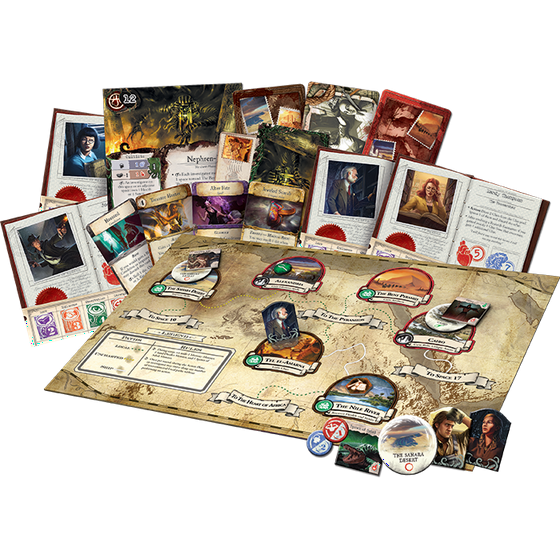
Egypt side board (promotional image from Walmart)


Highlights:
  • Great teamwork in round one. Father Matteo gets cursed right off the bat (only a roll of 6 on d6 is now a success), but we also get handed a countdown-to-doom minor quest that involves chucking a bunch of Clues at the problem. Daniela can generate Clues for Resources (she gets one back per round, and earns one after resting or shopping), and we decide to meet in Arkham with Norman Withers, swap gear while we're there, hand her all the Clues we have, and solve the countdown quest the next turn.
  • Having to fight an epic monster (the Tick-Toc Men) in the Australian Outback and just nuking them from afar with spells and favors because we can't be arsed to make the trip.
  • Norman Withers banishing all kinds of monsters, like Clue-eating Shan Insects, and amassing a dread library of about 10 spells. He can hurt, heal, protect, teleport, summon, banish - and every time he rests, a Tome he got via Daniela's frequent shopping trips gives him an extra spell. All the booster artifacts he's received during the game add up to ~18 dice to roll.
  • Father Matteo handing out Blessings left and right (they make every dice roll easier; normally you have to roll 5-6 on d6 for a success, Blessing makes this 4-6). Daniela Reyes discovering that with her two free Resources per turn, she can effectively buy out the store without taking Debts. Her landing a Mi-Go Brain Cannister artifact, which lets the owner trade gear with someone else wherever they are. This frees up the other two players to solve problems and kick mummy ass. Very effective.

Debts: 2
Blessed: 4
Cursed: 1
Gates closed: 2
Monsters defeated: 3
Characters killed: 0
Characters devoured: 0
Dark Pacts taken: 0


Encore plus le Swag. Note that Daniela bought even more items than this, but shipped them to the other characters through the Mi-Go Brain Case. Handy little gizmo. We worry that we're becoming the cultists everybody is so afraid of.

 SESSION THREE - YIG THE SERPENT

My wife and I have a running gag about the Serpent Folk monster: when you draw it, it automatically moves to the Amazon location and has a chance of luring you 1 movement closer to it in the Mythos phase - except in our years of playing, it always fails to, or only succeeds when we actually need that one extra movement. His master Yig from the Forsaken Lore expansion is different business entirely though, handing out the horrible Poisoned condition which prevents you from recovering health/sanity during rest actions and can damage you during the Mythos phase. For our next Old One in line, we pick Hastur from the Signs of Carcosa expansion. He'll try and drive us mad while we hunt for snakes.

Really, this is a cakewalk. Not because we're that good, or because Yig is a pushover, but because we have two games worth of gear and spells right from the get-go and can unload hellish damage on even the slightest sign of trouble.

Afraid we're getting cocky, we warn each other that there's lots of Mythos cards that punish you for having too much gear or spells. We could look at 1 damage for each item or spell you have, for instance, with us lugging around ~10 of those each and even the strongest character only having 7-8 hit points. You get to discard cards to prevent this damage of course, but who wants to be forced between keeping Excalibur or the Necronomicon?

In the end, the Mythos is kind to us and we mop up Yig in no time. So fast, even, that we discuss prepping for the next game by doing some shopping while we keep Yig on life support. Funnily enough, the game isn't having any of that and a rare positive Mythos card ends up solving Yig's resurrection before we can amass even more ridiculous wealth.

Norman Withers has changed disciplines from astronomy to applied necromancy. Lab equipment to boost casting of his scary collection of spells partially funded by the ridiculously handy Resource mechanic.


Debts: 0
Blessed: 3
Cursed: 1
Gates closed: 4
Monsters defeated: 11
Characters killed: 0
Characters devoured: 0
Dark Pacts taken: 0

LESSON LEARNED

Eldritch Horror isn't designed to handle you keeping gear between sessions. It's great fun wiping the floor with our opponents for once though! I'm sure that our hubris will get rewarded during the next three sessions.