Saturday, 19 January 2019

Warlock Patron: the Hungry Crone

Warlocks work with old, dark forces for power that society won't give them. Here's the first Patron spirit to petition. Part of a series. Rules and overview here.

THE HUNGRY CRONE

Patrons are aimed at specific Estates but will welcome anyone's service. Here's one for downtrodden commoners in the Third Estate. Based directly on Gloomtrain's Hungry Crone.

She visits her coven at the witching hour as an ancient woman, impossibly twisted and shivering. The Hungry Crone brings cold, curses, and resolve. Her hate is for those who are blessed with life, beauty, status and children. She does not love.

Alternate versions: the Bitter Abbess teaches harsh lessons to the faithful. The Austere Stewardess has no patience with mewling subjects.

Three witches - from


MINOR PACT
  • To summon: expose yourself to the elements under the New Moon and cry her name three times at the witching hour.
  • When: whenever you gain a feat, or swap out an existing feat, or give up 2 ability points.
  • Service: roll once on the Hungry Crone's list of tasks below.
  • Forbiddance: you can never return another person's love.
    Gain: either the Ritual Caster or Magic Initiate feat.


MAJOR PACT
  • To summon: expose yourself to the elements under the New Moon and cry her name three times at the witching hour.
  • When: whenever you have enough XP to gain a level.
  • Service: roll on the Hungry Crone's list of tasks below, every time you gain a level.
  • Forbiddance: you can never return another person's love.
  • Gain: a Warlock level

From


Hungry Crone spells


spell level
spells (choose two per spell level)
1
fog cloud, hideous laughter, sanctuary
2
animal messenger, blindness/deafness, pass without trace
3
bestow curse, fear, sleet storm
4
blight, ice storm, polymorph
5
contagion, dream, geas


Hungry Crone gifts

Stolen Vitality

Starting at 1st level, when you reduce a hostile creature to 0 hit points, you gain temporary hit points equal to your Charisma modifier + your warlock level (minimum of 1).

Entropic Ward

At 6th level, you learn to magically ward yourself against attack and to turn an enemy's failed strike into good luck for yourself. When a creature makes an attack roll against you, you can use your reaction to impose disadvantage on that roll. If the attack misses you, your next attack roll against the creature has advantage if you make it before the end of your next turn.

Once you use this feature, you can't use it again until you finish a short or long rest.

Icy Heart

At 10th level, your patron teaches you how to turn the mind-affecting magic of your enemies against them. You are immune to being charmed, and when another creature attempts to charm you, you can use your reaction to attempt to turn the charm back on that creature. The creature must succeed on a Wisdom saving throw against your warlock spell save DC or be charmed by you for 1 minute or until the creature takes any damage.

Join the Coven, they said. From

It beats being cold and hungr all the time, they said. From


Hungry Crone tasks 
The lessons of the Crone require payment of health and twisted devotion to the coven. Her servants may perform these tasks themselves or trick someone into performing them. To gain a warlock level, roll on this chart (d20) and fulfil the Crone's demands.

  1. My stomach growls. Give me your (d8) 1-2 toe. 3-4 finger. 5 hand. 6 foot. 7 eye. 8 tongue (cannot speak but can mewl spells).
  2. I hunger so but the pious misers in the village refuse me. Spoil their feast by hiding a knot of frog skulls and rat tails in the village food storage.
  3. The baron feasts nightly while his serfs break their backs on his fields. Replace the bread and meat in the castle stores with these stones and distribute the food to the poorest serfs.
  4. A hunter steals the meat from my traps. Hobble him and leave him for the wolves.
  5. I wish to have one of your nonborn - an egg or semen sample.
  6. Secretly place this toad in the well of the midwife's house.
  7. The Baroness has a beautiful child. Bring it to the forest at the witching hour for (d4) 1 a blessing. 2 a curse. 3 an instruction. 4 a swap with a changeling babe.
  8. The young lady of the manor cannot bear child and is about to be turned out into the cold. Take this sack of sticks, blood and faeces and bury it under a tile in her bedroom that she may be with child.
  9. My cauldron requires your blood. Painful, weakening (d4) 1 pin prick - 1 hp damage. 2 thimble - 2 hp damage. 3 a pint; [level] hp damage and 1 level of fatigue. 4 three pints; 3*[level] hp damage and 2 levels of fatigue. Hit points heal at 2/night; fatigue heals when these hit points are all healed.
  10. The wild hunt draws near. Lend me your vitality that I may survive their attack. Once a night at witching hour for the next d4 nights (exploding), lose [level] hit points and suffer a level of fatigue. You heal only half the normal amount during this period.
  11. Cold and ache squeeze my poor old bones. Share your warmth with me. For the next week, you suffer from cold whatever the weather and have disadvantage at Dexterity saves. Lighting a fire and hunkering close will help, but the fire chews through fuel thrice as fast.
  12. Let me experience youth once more - age 1d10 years.
  13. My senses are old and feeble. Give me one of your senses for a week and a day: (d4) 1 sight. 2 hearing. 3 taste and smell. 4 touch. (Take a -4 penalty to rolls involving this sense; attack rolls, perception checks, fine motor skills.)
  14. Lend me the use of your voice for a day and a night. You are mute but can still howl spells - your speech is under the control of the Crone and may appear anywhere.
  15. Your body is strong. Grant me its use during the night. For d4 (exploding) nights, you wake up in the morning within a mile of where you went to sleep, without knowing what happened. Covered with (d4) 1 blood. 2 mud and scrapes. 3 whip marks. 4 a knight's bed sheet.
  16. Bring a root of the Mandrake from the graveyard to the apothecary's servant girl.
  17. One of mine has been held for a crime. Frame another for it so s/he may walk free: (d4) 1 theft of food. 2 brewing of poisons. 3 cursing another with infertility. 4 performing black magic.
  18. A priest of the Authority has planted a shrine in the village. Desecrate it with the blood of wild animals. Do it tonight.
  19. One of mine has betrayed me. This wretch has been taken in by an order of monks and is fasting in their chapel before their morning confession. Bring me their lying tongue.
  20. Take this grimoire of dark spells and bring it to my servant in the (d4) 1 nearby farm. 2 town council. 3 monastery herb garden. 4 castle dungeon.

Warlocks get the best gifts

I have dark ages on the brain. Belswick has a society like a cage, with nobles who rule your life and priests who decide what happens when you die. Even wizards have locked themselves into sanctioned colleges. In short: know your place in the dirt. An excellent setting for people who like to break the rules. Sound like any players you know? Then tempt them to go all the way and become a damned witch or warlock!

Society mistrusts you anyway. Why be a rogue when you could be a warlock? From

Design goal: to make warlockry tempting and dangerous. 5e does an ok job in balancing all the classes, so how do I make this one class more attractive than others? One, by throttling regular casters, for instance having their cantrip spells cost precious spell slots while warlocks cast cantrips for free. Two, by tying caster types to controlling hierarchies and class advancement to quests for their masters, while warlocks get power with a simple rite.

Warlock Patrons are servants of the Exile, the big Satan figure of my setting. S/he is way too filled with rage over being kicked out of Heaven to tempt mortals. That's what the Patron spirits are for. Warlock patrons exist to unbalance the orderly society of the Authority. They seduce members of all Three Estates with easy power, in return for the occasional service.


Summoning circles, complex incantations? You won't need anything that complicated to get a Patron's attention.
From

ON INSPIRATION

Mateo Diaz Torres wrote a series of inspiring posts about warlock Patrons; what I've done here is take his idea of service-for-power and write up Patrons for a feudal game of D&D 5e. The powers are reskins of existing warlock abilities, services and forbiddances come either directly from Mateo, from a Goblin Punch / Coins & Scrolls wizard school, or from myself.

ON TONE

How do you run black magic - quick and awesome power, vile and soulcrushing heresy, high farce? I have no illusion where my group will end up falling. Ultimately, it's up to your taste as a player, DM and gaming group how much horrific detail you want to give to warlocks and their dark pacts. I'll do this write-up in a serious tone, but without making everything too grimdark. Season to taste.

There are certain downsides to being suspected of warlockry or witchcraft. But that keeps life interesting.
From

BECOMING A WARLOCK

Making a Pact with a Patron
Patrons offer their services to many and getting their attention is seductively easy. So is getting power out of the relationship. Followers from any class can make a minor pact with a Patron by taking the Magic Initiate or Ritual Caster feat (summary below). Taking actual warlock levels means making a major pact - no way around that.

Both the minor or the major pact bind you to observe a Patron's forbiddance, something you have to do or refrain from at all times. Roll a Wisdom save at difficulty 10+1/day of disobedience or suffer a Severe Curse. Roll this save at disadvantage for heinous transgressions. (Like a warlock of the Hungry Crone being in a loving marriage, or the master of the Blistered Squire helping put out the inferno in the monks' library.)

Major pact: warlock levels
It's one and the same: sign (or add to) a Major Pact to take a level in the Warlock class. Each patron gives access to extra spells and specific powers. You'll have to observe the Patron's forbiddance and perform services for it whenever you gain a level after becoming a warlock.

At least one of these fine people got to their exalted position by warlockry. From


Minor pact: magic initiate feat or ritual caster
You summon a Patron spirit and make a pact to bargain your soul for power. You have to perform a service for your Patron and observe its forbiddance.

When: whenever you gain a feat, or swap out an existing feat, or give up 2 ability points.
Service: roll once on the Patron's list of tasks.

In return you gain either:
  • magic initiate: learn two cantrips of your choice from the bard/warlock/wizard list that you can cast as an action every round. You also know one 1st level spell from the warlock list or from your Patron's spell list; you can cast this spell once per day at its lowest level and it refreshes after a long rest.
  • ritual caster: receive a book with two ritual spells from the bard, warlock or wizard lists. You can copy in other ritual spells from these lists that you find, at the regular cost of (50 gp and 2 hours) per spell level. Roll Arcana skill, difficulty 10+spell level; failure means you lose 2 hours and 50 gp. You can only learn spells of half your character level (round up).

Note: regular casters in my game also always know their cantrips without having to explicitly memorize them, but activating a cantrip costs a 1st level spell slot until these casters perform a minor rite with their mentor. For warlocks, cantrips are free to cast every round as an action.

Enough rules - let's party
From

Thursday, 17 January 2019

Wizards: the Enlightened Order of the Silver Rose

The Enlightened Order of the Silver Rose are chartered wizard order number four and last in Belswick. (There's two more orders that I want to write up, but they're decidedly less legal.)

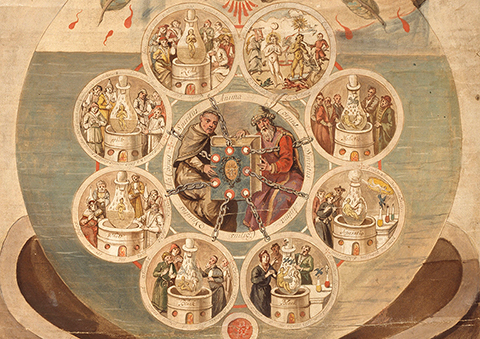
Alchemical practices.
  Alchemists Revealing Secrets from the Book of Seven Seals, The Ripley Scroll (detail), ca. 1700. 950053
Source: Getty.edu

THE ENLIGHTENED ORDER OF THE SILVER ROSE

("Order of the Rose, the Silver Rose, Rose Wizards, alchemists")

The Silver Rose (a symbol of purity and transmutation) specializes in understanding and then changing the material world. As such, their students tend towards careers in hedge wizardry with a sideline in potion selling - quite profitable indeed. Their theories and practices revolve around purifying base elements and creatures and incorporating the essences of more noble creatures and materials. The Rose's understanding of base and noble elements makes them ideal alchemists, but also attracts lead-to-gold hucksters. They maintain a bulletin board with all the letters from crackpots who claim they've transmuted metals to gold.


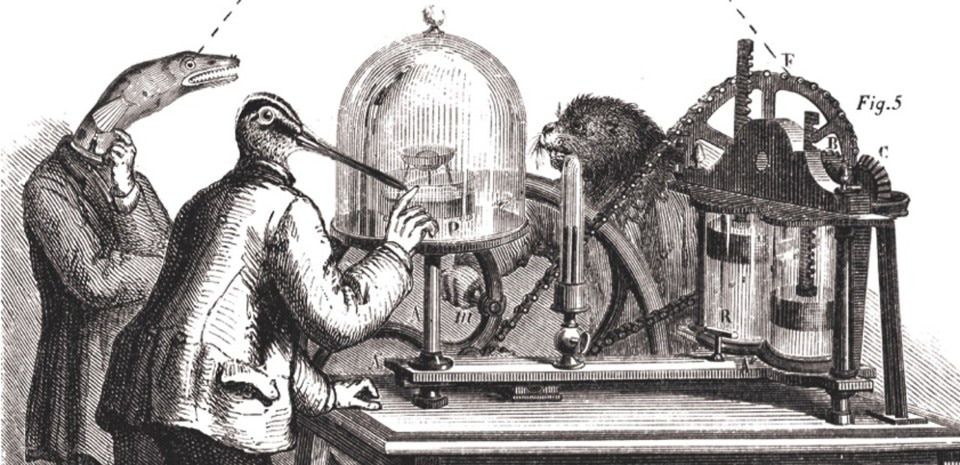
Professional alchemists (fishling, birdling and otterling)
From

Relations and views


Cures gout, scrufola, algae and overabundance of gold.
From

Typical gear
Formal wear for the alchemists is not a charred leather lab suit.

(For how exciting lab work can get, check out these brilliant posts on mercury azides, chlorine trifluoride (which can burn sand and asbestos), Hexanitrohexaazaisowurtzitane, and the awe-inspiring FOOF)

Rose gear does tend to be very practical. The Order is relatively new but spread wide, and advancement is based more on ability than on dry following of the correct traditions. For formal occasions, the Order of the Rose wears a silver brooch of a rose pinned on a pale blue robe. Their arcane implement is a wand or a cup.

Benefits: specialties, spell access and lore
  • exclusively Transmutation specialists.
  • Students start with an alchemist's kit and recipes for two alchemical items.
  • A member in good standing (and not behind on their payments) receives access to one transmutation spell they can cast per level. In addition to levels 1-6 of Transmutation, the Order's library also contains spells from the schools of Abjuration (levels 1-2), Divination (levels 1-2) and Evocation (levels 1-2). Higher level spells than these can be obtained from the Unbroken Circle on an individual basis and at 50% higher prices.

Favors for the Rose

The Order of the Rose can teach wizards how to cast Cantrip spells without expending magical energy, and can provide training as a Transmutation specialist.

Learn to cast Cantrips without spending spell slots at level 3:
You are given two potions. One is deadly poison, the other an alchemical potion. Which is which?   

Learn Transmutation school features

level 2: the Oil of Transfiguration
To temporarily transmute elements, you will need a base oil worth 100 gp. In addition, gather the following ingredients, fresh as possible:
  • pure iron (unrusted), copper and silver
  • a twig or leaf from a Dryad or Treant
  • a chip of living stone

Dragon of the Transmutation of Metals
From

level 6: the Transmuter's Stone
Perfecting your Transmuter's Stone will take base ingredients worth 250 gp. In addition, obtain the following ingredients, fresh as can be:
  • an owlbear's eye
  • a vial of pixie dust
  • a bezoar from a basilisk's stomach
  • a troll's heart

While compounding Philosopher's Stone, take care
not to inhale gaseous expulsions, as these may
prove hallucinogenic. From

level 10: the Inconstant Form
To learn the secrets of Polymorphing, you will need brew a potion out of valuable ingredients worth 500 gp and infuse it with the essence of creatures that merge different beasts in themselves. Obtain the following, live or pure as you can:
  • the roiling flesh of a gibbering mouther
  • a mimic's heart
  • a lycanthrope's tooth
  • three eyes of a chimera
  • a griffon's claws
  • a hippogriff's mane
  • a pegasus' hoof
  • three spikes from a manticore, given by the beast with its blessing
  • a live frog and a sheep's skin

Obnoxious rabbitling go bye-bye now. From


level 14: the Magnum Opus
No less than 1000 gp of base ingredients are needed to attempt this complex transformation. As you progress through the Magnum Opus ('great work'), you will add the following to your transmuter's stone to purify its very essence. To gain each separate ability of the Master Transmuter power of a Transmutation specialist, gather the following:
  • major transformation:
    • a salamander's tongue
    • a rust monster's antenna, straight off the beast
    • a will-o-wisp's light
  • panacea:
    • wrappings from a mummy out of the Far Lands
    • the song of a false hydra
    • a live black lotus flower
  • restore life:
    • a phoenix feather
    • a medusa's tears
    • a shadow's caress
  • restore youth:
    • a high elf's first memory
    • a nymph's kiss
    • a naga devouring itself

Tuesday, 15 January 2019

Wizards: the Fraternity of the Comet

Third wizardly order of Belswick, written while on a Jack Vance binge (warning: TV Tropes).

Even the most inbred of nobles recognize the value of a well-healed peasant who can throw around fire on the battlefield. An army might hire a member of the Order of the Circle for versatility, a mage of the Lodge for insight. An honourless sort might even employ the Violet Cloud for assassination. But in a full scale battle, the Fraternity of the Comet has no peers.

Not the best of omens, no.
Woodcut showing destructive influence of a fourth century comet from Stanilaus Lubienietski's Theatrum Cometicum (Amsterdam, 1668).

THE FRATERNITY OF THE COMET

("the Comet, elementalists, doom bringers, fire hurlers")

The Comet is an ancient symbol of change and ill omen, quite immediately so when it falls* to the earth and hits you. The same goes for the Fraternity of the Comet (open to both genders). The Fraternity started as a guild of alchemists with a fetish for smoke powder. It received formal approval to study evocation magic and opened as a college for war magic 197 years ago. Graduates are employed by nobles, mercenary companies and sometimes even the Church. They are only very rarely allowed to settle somewhere as a hedge wizard.

* Yes, you science pedants, comets aren't falling stars. Now be still.


And frankly, who'd want you as a neighbour?
A medieval painting dated 1456 AD, depicting a pass of Halley's Comet.


The Fraternity has no formal ties with the Church, but it is well aware that knowledge of the higher spell circles is verboten. A sub-order called the Company of the Excellent Prismatic Spray still dares to search old tombs and towers for legendary evocations such as the Effulgent Meteor Swarm. Members live in dread of what would happen when the Church should learn about their quest. The Church Order of the Gustavinians in turn knows about the Company and less bothered than you'd think. High level evocations only kill. It's wizardly access to the planes that worries the First Estate, and so the Company of the Excellent Prismatic Spray is monitored to see if their search unearths more dangerous magics.

Relations and views


What you thought you'd be doing. From the Svilland kickstarter

Typical gear
After graduation an Elementalist wears sturdy traveling clothes with a black cloak trimmed red; formal wear is a robe of darkest blue with an amulet of a comet done in blue, green, red or brown (for elemental specialisations of air, water, fire and earth). Their arcane implement is an oak rod, preferably from a tree struck by lighting. Bands of meteoric iron complete the look.

What your Liege will be demanding of you. From


Benefits: specialties, spell access and lore
  • exclusively Evocation specialists.
  • Students start with an explorer's pack and can use the Arcana skill to find weak spots in fortifications. Taught the recipe for Alchemist's Fire. More advanced recipes exist for higher initiates.
  • A member in good standing (and not behind on their payments) receives access to one evocation spell they can cast per level. In addition to levels 1-6 of Evocation, the Fraternity library also contains spells from the schools of Abjuration (levels 1-3), Conjuration (levels 1-2), Divination (levels 1-2) and Transmutation (levels 1-3).


What you're actually doing. From
Favors for the Comet

The Fraternity can teach wizards how to cast Cantrip spells without expending magical energy, and can provide training as a Divination specialist. In return, the Fraternity requires a service from you.

Learn to cast Cantrips without spending spell slots at level 3:
Take out a vile monster without using spells.

Learn Evocation school features
  • level 2: the Garden Challenge
    Use your spells to eradicate a pest of summoned beasts but do not harm the delicate statues and plants in the Dean's Garden.
  • level 6: the Marksman Challenge
    Using only Cantrips, take out a dextrous opponent that dances away from your bolts.
  • level 10:  the Furnace Challenge
    Take out a fortified position using your spells as efficiently as you can.
  • level 14:  the Heart Lesson
    A great beast is loosed - slay it for the Comet.
How your squad mates see you.
d4 Vile Monsters
  1. a ghoul
  2. an orc
  3. a basilisk
  4. an owlbear

d3 Summoned Beasts
  1. fire mephits
  2. skeletons and zombies
  3. a water weird

d4 Dextrous Opponents
  1. an air elemental
  2. a harpy
  3. a manticore
  4. three will-o-wisps

d6 Fortified Positions
  1. a guard tower overtaken by bandits
  2. a wind mill is the lair of a necromancer
  3. the graveyard houses a wight and its wraith guard
  4. the old standing stones have weakened and let through a pack of Orcs
  5. a church in the forest is the home of a Warlock cult
  6. an cave-riddled island in a swift river, home to three trolls

d8 Greater Beasts
  1. a giant lured onto the moor
  2. a treant corrupted by darkness
  3. a hydra changed to breathe fire
  4. a beholder set free from the depths
  5. a golem broken free of its commands
  6. a wyvern maddened by purple flowers
  7. a foul demon summoned to plague the meek
  8. a dragon woken from sleep

Saturday, 12 January 2019

Wizards: The Exquisite Lodge of Augurs and Diviners

Another wizardly order in Belswick. These Orders exist to control the commoners that are taught dangerous magic (the First and Second Estate would never sully their hands with it). There are reasons why wizards only know spells of levels 1 through 6. The Augurs and Diviners use their insight to help the crown and steer commerce. Meanwhile they secretly look for higher circles of power.

THE EXQUISITE LODGE OF AUGURS AND DIVINERS

("the Diviners, the Lodge")
From

Offshoot of the Unbroken Circle with the same monastic teaching tradition but no formal ties to the Church. The Diviners split from the Circle 234 years ago to pursue more specialized knowledge than the Order (and its Church handlers) were willing to explore. Knowing too much about the outer planes is...discouraged, after all. Clever manoeuvring (it's almost as if the Lodge knew the time was ripe) resulted in backing from the Royal Court to specialize in magical information gathering. How could it be wrong to make the right knowledge available to the right people?

Early generations of Lodge students always had a tie to the nobility, in blood or in close relations with the local court. Nowadays merchants also send their sons to the Exquisite Lodge of Augurs and Diviners. Peasants are admitted if they pass a general knowledge test or are sponsored by a noble, but the Lodge does not train those who do not have the contacts to make the most of its teachings. It has close ties to guilds of navigation, cartography, glassblowing and lens grinding.

It's not what you know, it's what business opportunities you create with it. From

In addition to focused divination knowledge, students also study worldly knowledge such as investigation, trade, and geography. The Lodge does contract work as translators and bounty hunters for both merchant and noble houses. Lodge members are expected to share information freely with each other, but do not divulge who contributed such insights. In practice, many graduates' allegiance is to their noble master or merchant house - they find themselves subtly excluded from core Lodge business.

Of late, the Lodge has been sponsoring long distance trade with very good results. This is also an excellent cover for its search for higher circle wizard spells. The Master Library already holds Symbol, Mind Blank and Telepathy. This quest is only known to the College of Deans, but lower professors and lecturers wouldn't be worth their salt (prices about to rise due to a shipwreck, buy now before word hits the market) if they couldn't guess what the Lodge was up to.

Relations and views
Why did you think it was all robes and sigils? From


Typical gear
Formal wear after graduation for the Diviners is simple grey robes with a star or moon motif embroidery. Their arcane implement is an orb. In practice, the Lodge likes to show its wealth with beautiful trophies, quality clothes and excellent food and amusements.

Benefits: specialties, spell access and lore
  • The Augurs and Diviners exclusively train as Divination specialists.
  • Students may take proficiency in one extra wizard skill or one of these toolkits: Cartographer, Glassblower, Lens Grinder, Navigator
  • A member in good standing (and not behind on their payments) receives access to all divinations they can cast. The library of the Lodge contains levels 1-6 of Divination and spells from the schools of Abjuration (levels 1-6), Illusion (levels 1-4) and Enchantment (levels 1-4). Transmutation and Evocation spells can be sourced at 50% markup through contacts in the Order of the Unbroken Circle.

Favors for the Lodge

The Lodge can teach wizards how to cast Cantrip spells without expending magical energy, and can provide training as a Divination specialist. In return, the Lodge requires a service from you.
  • get initial training as a specialty wizard at level 2: roll 1d6
  • perform the rite to cast Cantrips without spending spell slots: roll 2d6
  • learn specialty school features at (level 6,10,14): roll 3d6

  1. Spend 1d3 weeks as a teaching assistant in an introductory class
  2. Collect the spellbook of a deceased Lodge member
  3. Provide spellcasting support to the Lodge: spend 5*your available spell slots over 1 week time
  4. Find out how smugglers are getting their wares across the border
  5. Investigate an act of (d8): 1 swindle, 2 vandalism, 3 robbery, 4 burglary, 5 smuggling, 6 assault, 7 arson, 8 murder
  6. Find a runaway (d6): 1 serf, 2 guild apprentice, 3 guard, 4 squire, 5 noble's heir
  7. A [guild] is negotiating a large shipment of their [prize product] - find out the bulk price
  8. A shipment of [prize product] is held up by tax inspectors - make them release the cargo without inspecting it
  9. A minstrel is telling surprisingly accurate stories about the Far Lands. Find out how they got this information
  10. A spy has been relaying information from privy council - find out who and how
  11. We see a trade opportunity opening up, but do not want to tip our hand to the [guild] - find middlemen to buy the cargo for us
  12. What on earth are the Dwarfs buying all that food and fuel for? Investigate.
  13. Our friends in the lens grinders's guild want to test a new contraption. Go with them on a field trip (d4) 1 out to sea, 2 to the hills 3 to an abandoned watch tower 4 to the castle.
  14. The Order of St Gustau wants to know how a village wizard learned advanced conjuration
  15. A demon plagues a noble house. Find it, excorcise it - and see if you can't keep in touch with it for valuable information down the line
  16. One of our trade ships has not made it to its destination port. Find out what happened.
  17. The Olmadicians have a cloister where sleeping priests pray to sleeping godlings. Infiltrate such a dream prison to recover precious information
  18. There is a tower with a door no-one can open and a room no-one can enter. It holds a book that holds a map to a fragment of higher level magic. Find it.