Showing posts with label house rules. Show all posts

Saturday, 18 July 2020

Chase rules

First non-session log post in ages! I'm going to run a city campaign for/about a bunch of thieves, and I wanted to offer more explicit options to resolve situations than fighting, bluffing and stealth. Here's the chase system I'll be using; a slightly tweaked Night's Black Agents with encounters for a bog standard low-magic medieval fantasy setting.

Chase scenes are about outwitting and outrunning your opponent. They should be frantic, vivd, fast-paced. And everybody in the group should be able to contribute. I want to run this off the cuff, which means I don't want to micro-manage and plan out every last little obstacle, juggle movement speeds per character, initiative, opportunity attacks and so on.

Eberron skycoach chase in Sharn

I'll run chases as extended opposed skill checks. Yes, it's a reviled D&D 4e mechanic, yes we'll make it work anyway. My goal is a fast movie montage of cool situations and quick decisions, not endless fiddling with modifiers. I also want variety in the challenges; not just comparing movement speeds, but throwing up situations for the players to navigate in (hopefully) new and exciting ways. I'm choosing a system that treats a group of chasers or runners as one single entity, so that I don't have the hassle of tracking how far ahead each individual is. Speed over detail here.

Night's Black Agents has a perfect little system - I only needed to file off the serial numbers and write up a bunch of obstacles. Rules first, obstacles and persistent conditions at the bottom of the post. This is written for a 5e game in a lowish-magic setting like the City of Lankhmar. In a place with a lot of low level magic like Eberron, spice things up with feather fall tokens, boots of jumping and so on.

Optional rules for those who like more crunch are in italics. They can mostly be used independent of each other.


>> USE THIS CHASE TRACKER FOR D&D 5E [ google doc ] <<

CHASE RULES

Set-up. Runners are the people trying to get away, Chasers are the ones trying to catch them. You track the distance between the two groups in an abstract way using the Lead stat. Runners need to reach a certain Lead to escape, Runners want to reduce that Lead to 0.

  • Draw one box for each number of Lead on some scrap paper; track the Runner's Lead with a token like a die, a coin or a mini.
  • If you're aiming for immersion, don't show the players the progress track - only describe if they're pulling away, close to getting caught, how close they are to their goal etc.
  • If you really need to know exact distances, assign ranges for spells and attacks to different brackets of Lead. Lead 0-2 is 0-60 feet, Lead 3-6 is 60-200 feet, Lead 7-14 is 200-1000 feet.

Lead and Obstacles. The way you change Lead is by going through Obstacles; quick little situations you can navigate in a ton of different ways. Select Obstacles in advance or roll them as you go. Be prepared for a chase to hit the rooftops, sewers, water etc - I've included slightly longer lists for those environments.

The Runner starts with a Lead halfway to their Target, depending on the overall terrain:
  • Crowded, twisty alleys, lots of obstacles: start at Lead 3, escape at Lead 6.
    +1 bonus to rolls to the most agile group (highest average Dex), adjust initial Lead by 1 in their favor
  • Minor obstacles: start at Lead 5, escape at Lead 10.
    +1 bonus to rolls to the fastest group (highest average Speed), adjust initial Lead by 1 in their favor
  • Wide open terrain: start at Lead 7, escape at Lead 14.
    +1 bonus rolls to the group with the best endurance (highest average Con), adjust initial Lead by 1 in their favor
  • Initial conditions: ± 1-3 to Lead for an (un)favorable start like being surprised by guards, sabotaging the opponents' cart etc.


Have you tried just walking at street level?

Have the group pick a leader for the round and let them describe their approach. Each group moves as one close-packed group. Every round, another player heads each group and rolls a skill check to try and overcome the Obstacle.
  • Every skill is fair game, if the player can describe how they try to use it to navigate the Obstacle. Allow for crazy stunts and reward those in narration. In 5e, you can always give +d6 Inspiration for a really cool idea.
  • The base difficulty for the skill check is 13.
  • Each round, the head Runner may decide to raise the stakes by upping the Difficulty by 1. They may also keep it at the current level. The Difficulty may only be lowered by 1 (down to 13) when both the head Runner and Pursuer agree. This represents choosing a faster pace, a more difficult route or some other risky stratagem. Ask them to describe how they see this raise looking in the fiction.
  • If the lead character wants to use a skill that their group already used before in this chase, up their Difficulty for this roll by 1 - stimulates creative solution.
  • Up the difficulty by 1 if a character has headed the roll-off before - this both simulates the group getting tired and stimulates them to let everyone in the group take a turn.

Roll-off. Best roll changes Lead in that group's favor. Describe the results of the rolls, tell your players how close they are to catching or escaping their opponents, and go for the next Obstacle. If the chase is heading in a particular direction (you need to reach the boat / catch the cultist before they reach their safe house), mention how close you're getting.

  • Runner fails, Pursuer succeeds: Lead shortens by 2.
  • Runner and Pursuer both succeed or fail: Lead changes by 1 according to whose margin was greater. In case of an exact tie, keep the Lead as-is.
  • Runner succeeds, Pursuer fails: Lead lengthens by 2.
  • If either party rolls a 1, add a Condition and up the Difficulty by 1. (See bottom of post for examples). If either party rolls a 20, they can remove an ongoing Condition and reduce the Difficulty by 1.
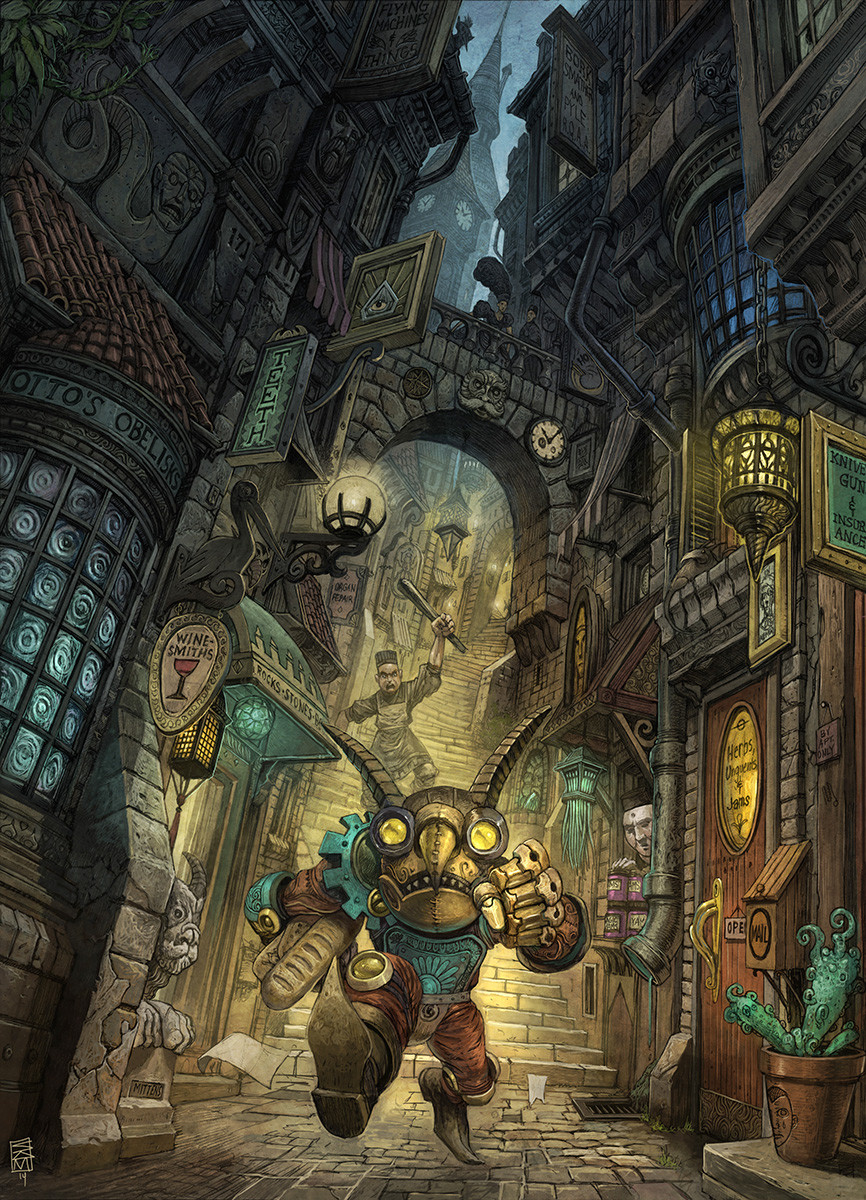
The Goblin Chase, by Sean Andrew Murray

RUNNING A CHASE

Pick an Obstacle. Describe quickly what the group sees - this is all happening on the run. First impressions, one big hit of flavor, then boom: who takes point? What do you do?

You'll get questions from your group. Fine, use those to flesh out the scene. Try to keep that to under one minute though, this is about keeping a frantic pace.

Have the head Runner for the group describe their approach and pick a skill for it, then the same for the Pursuers. Describe results: this is going to be chaotic, lean into that. Reward crazy ideas with cool descriptions, then on to the next Obstacle!


THINKING ABOUT OBSTACLES

Ideally, Obstacles are situations that the players can decide to tackle in lots of different ways, not a straightjacket to which there is only one answer. So, "You run into an alley full of street food vendors, with drunks and hot grease everywhere - what do you do?", instead of "there's a closed fence - roll for lock picking!")

My advice is to pick or roll a bunch of Obstacles ahead of time so you can keep up the pace during the chase without having to consult tables all the time. Of course if your group decides to head for the roof tops / into the sewers / back to the streets, you'll need to find appropriate new Obstacles, but it pays to have some pre-selected.


OPTIONAL CHASE RULES


Only recommended if you've got the basic Chase rhythm down.

  • One Runner and one Pursuer character may choose to take an action (ranged attack or cast a spell) to try and change the Difficulty for the round. This always raises their group's Difficulty by 1.

    For instance, a druid could summon a thicket of brambles to tangle his pursuers and give them +1 Difficulty, or a wizard could cast haste to give his group an ongoing -1 Difficulty. The idea is not to drop into blow-by-blow combat during a Chase - that's what the combat rules are for. Reflect the effect of the player's action in the round's Difficulty and move on.
  • Runners can choose to split the party at the start of a new round; the Pursuers then have the option of sticking with one group or splitting up as well. Deception / Insight checks might be necessary if the Runners want to hide which group has the MacGuffin, hostage, etc. (No casting spells or attacks this round; this counts as one character's action - see below.)
    • If both groups split up, run this as two separate Leads to close or open up. Botches and Criticals still inflict / alleviate Conditions.
    • If the Pursuers stick together, increase the Difficulty for their Runners by +1 to represent them being hounded by a comparatively larger group. The other Runners escape.
  • At Lead [target -2] or higher, the Runner may make an additional skill check at Difficulty +2 to make a sudden escape; the lead character decides how they suddenly manage to give their Pursuers the slip. Failure ups their Difficulty by 1 for the rest of the chase. Depending on your system, inflict subdual damage or exhaustion as a cart crashes, ankles are twisted after a long drop and so on. As before, skills used already once before incure a +1 Difficulty, so just spamming "we run extra hard and roll Athletics" is not a winning strategy.
  • At Lead 2 or below, the Pursuer may make an additional check at Difficulty +2 to grab the Runner in a final burst of speed. The lead Pursuer describes how this happens and which skill they want to use. Failure ups the Pursuers' Difficulty by 1 for the rest of the chase. Depending on your system, inflict subdual damage or exhaustion.


OBSTACLES

FINALLY, shit to pepper your chase with. Either plan these out ahead of time (so you can foreshadow) or roll as you go along. Sewers and rooftops have longer lists, because face it, your players will go there first chance they get.

Street market (d12)
  1. Pottery merchant on obstinate donkey
  2. Cart with wine barrels
  3. Oil barrels waiting to be carried inside
  4. Carpet vendor
  5. Street food vendor, lots of grease and hot coals
  6. Busy market square
  7. Slippery, smelly fish market
  8. Porters taking a break, street filled with their haul
  9. Stampeding herd animals
  10. Escaped flock of poultry and their owner
  11. Escaped exotic wild animal, owners shouting not to hurt it
  12. Cock or dog fight

A complication (d12)
  1. Doom prophet loudly denouncing you to his flock
  2. Jugglers and the crowd around them
  3. Bar fight spilled into the street
  4. Loan shark thinks you owe them
  5. Assassins mistake you for their quarry
  6. Clandestine drugs sale to noble's servants
  7. Frantic victim asking to help escape kidnappers
  8. Man begging wife for forgiveness as she throws his stuff out the window
  9. Guards sleeping lightly on the job
  10. Bunch of prostitutes trying to turn a trick
  11. Robbers beating up victim in back alley
  12. Murderous black fog out to throttle someone

Crowd (d12)
  1. Mimes and living statues, invisible walls & illusionary obstacles
  2. Road full of tired, disoriented pilgrims
  3. Funeral procession, black robes and lots of chanting
  4. Town cryer and group of listeners
  5. Priest giving outdoor sermon
  6. Bunch of guards saw you running and intercept
  7. Marriage ceremony in progress
  8. Pickpockets working a crowd - including you
  9. Bucket brigade trying to put out burning building
  10. Rowdy party-goers spoiling for a fight
  11. Workers revolting against unfair taxes
  12. Outdoor pub, wooden planks on barrels

Hindrance (d12)
  1. Slippery puddle of spilled oil or worse
  2. Alley deadends into tanner's worksplace
  3. Archway leads to a busy smithy
  4. Stairs turn into a bricked up doorway
  5. Alchemists guild disposing of acidic waste
  6. Inn keeper refusing to take delivery of substandard wine
  7. Two cart drivers refusing to give way
  8. Magnificent war horse blocks half the road
  9. Sedan chair with snooty noble and guards with big sticks
  10. Cart pulls out in front of you
  11. Idiot bard on horseback weaving across the street
  12. Two men very carefully carrying a plate of glass

Geography (d12)
  1. Cul-de-sac with rusty gate and closed doors
  2. Extremely narrow alley
  3. Sudden open square with long lines of sight
  4. Collapsed building filling road with rubble
  5. Lots of ankle-trapping potholes
  6. Dizzying cliff edge, view to lower level
  7. Overhanging wrought-iron balcony
  8. Run into cliff wall to higher level
  9. Narrow, rusted crate to the sewers
  10. Open sewer
  11. Narrow bridge across a stagnant canal
  12. Slippery quay with small boats

On the water (d12)
  1. River patrol demands you stop
  2. Fat river barge blocking the way
  3. Unusually large fish nudging boat
  4. Extremely low bridge dead ahead
  5. Pleasure boat with raucous party in your way
  6. Fishers arguing over whose turn it was to haul the net
  7. Swarm of rats climbing into the boat
  8. Floating debris blocking fast travel
  9. Three nobles in an illicit gathering
  10. Drunks pissing into the river, throwing rocks
  11. Rope covered in pitch across the water
  12. Assassin on the run jumps into boat, demands getaway

In the sewers (d20)
  1. Ancient cistern with exits halfway up the smooth walls
  2. Thieves exiting torn down wall into a cellar
  3. Meeting of Rat cultists
  4. Albino alligator drifting past
  5. Sudden flood of waste water
  6. Marsh gas, liable to explode
  7. Gate rusted shut
  8. Apprentice trying out some demon summoning
  9. Moonshine still with lots of flammable juice
  10. Sluice half-closed against the recent heavy rains
  11. Spider webs. Thin strands at first, then fat cables and curtains
  12. Unstable and slippery wooden plank leads to darkened side tunnel
  13. Flood of rats racing to you
  14. Three ghouls digging into a private crypt
  15. Tunnel lowers to slippery crawlspace
  16. Vermin collectors placing traps
  17. Underground market with illegal goods
  18. Shut-in commune asks gift to open gate
  19. Drug runners with a skiff full of green opium
  20. Guards with plague masks hunting drug smugglers

Rooftops (d20)
  1. Clotheslines, impossible to see past
  2. Damaged roof with lots of holes to fall through
  3. Red roof tiles that splinter and get slippery in rain
  4. Midnight drug users on a rooftop terrace
  5. Assassins getting ready for infiltration
  6. Rusty drainpipe will break if climbed incautiously
  7. Tyaa-bird (intelligent bird or harpy) making its way into a skylight
  8. Steep roof over a deep drop
  9. Big jump across the street
  10. Gusts of biting clouds from below
  11. Narrow beam across very wide street
  12. Thatched roof, catches your feet, very flammable
  13. Large stained glass window in the way; a skylight is open
  14. Next roof over is higher than this one
  15. Clattering roof tiles alert home owner and their dog
  16. Astrologer blocks path with elaborate, fragile telescope
  17. Glyph of Warding to ward off burglars on your path
  18. Spiky weathervine swinging back and forth
  19. Hatch to lower level is bolted from below
  20. Surprised smugglers accessing their secret stash

CONDITIONS

When either Pursuers or Runners roll a 1 on their skill check, inflict an ongoing Condition on everyone. If a party rolls a 20, they can choose to end one condition.

Every condition inflicts an ongoing problem on the Runners and Pursuers. The lead character in every group rolls a check against Difficulty every round or the group suffers the effects of one of these ongoing conditions:

  • Flash rains block sight, extinguish torches, make everything slippery. Dex save or the group loses 1 Lead.
  • Lightning storm disorients everyone with flashes and thunder. Wisdom save or the group loses 1 Lead.
  • Fire! A band of arsonists - or cultists? - has set fire to the neighbourhood. Dex save or everyone in the group takes d6 damage.
  • CLOUD OF HATRED. A hidden cult has summoned the Cloud of Hate. People riot in the streets. Wisdom save or the group members inflict d6 damage on each other; add +1 to the Difficulty of Obstacles involving people.
  • Festival! An obscure faith demands an impromptu celebration. Fireworks, loud trumpets, jostling crowds. Persuasion check or the group loses 1 Lead. 
  • The stars are right. Mad visions plague the living. Intelligence save or reroll your chase check.
  • All Thieves' Night. Impromptu celebration by the followers of a local thieving god. Perception roll or a random group member loses a small item like a purce, ring or amulet. Any objects the group just stole (probably the reason they're being chased) have a 1-in-6 chance of being stolen this way. If the roll misses by 5 or less, the group realizes the theft and can try to chase the thief. If not, they realize next round and can give chase at a higher Lead.


Sunday, 22 March 2020

5e haven turn: things to do during downtime

My players are putting down roots. No, not in the half-treant kind of way (although I wonder about our druid), but in the sense of building a place for themselves in the local community. Which means that downtime to do things around the village is just as interesting as a good adventure.

Here's a menu of options to give some more crunch to downtime. The framework is Papers & Pencils' Haven Turn, reworked for D&D 5e and my own campaign specifically. See this as a starting point, not a list that limits what is possible.


DOWNTIME: PCS IN THE DRIVERS SEAT

Papers and Pencils has his haven turn as one of the units of in-game time; combat round, exploration turn, wilderness travel watch, haven turn. His haven turns 'round out' the rest of the month until the next adventure.

In my view, haven turns or downtime are stretches of low-risk, time. Narratively, they work as a counterpoint to short, high-risk adventures. The players are in the driver's seat during a haven turn and can set long term plans in motion. Haven turns can morph into planning sessions and regular adventures or the other way around. They take place between more phrenetic and high-risk travel through dangerous terrain, dungeon delves, heists and so on.

As in P&P's original, players get one free haven turn for every two sessions spent adventuring (round up); they can take more haven turns, but run the risk of complications as they pay attention to their own affairs instead of to dastardly plots.

WHAT YOU CAN DO IN A HAVEN TURN

Haven turns are 'enough time to take care of some affairs'; they round out the rest of the month until the next adventure begins, disaster happens, players embark on a trip to clear out a wyvern's nest and so on.

To structure things, the DM goes around the table to ask how everyone wants to spend their haven turn; once there's a good overview, you then play out or summarize the results. Player actions can take negligble time, half a haven turn or an entire haven turn.

If the players want to take more haven actions than they have time for, they can choose to take another haven turn or break up part of their actions to be completed in a future haven turn.

Finally, if you have a background timer for war, plague or intrigue, roll an appropriate encounter.

Haven free actions
Cost negligable time during a haven turn. Basically a reminder to do your bookkeeping.

Haven actions
These take up half a haven turn each. A player can take an action marked * twice a haven turn to make faster progress in training/crafting.
  • buy basic gear, spells and potion recipes
  • training (see below) in a new skill/language/tool *
  • work on creating items such as potions and potions (see below) *
  • gather information by talking to NPCs
  • recruit NPCs for an adventure

Haven extended activities

These activities take up a full haven turn or more. Activities can be spread out over multiple haven turns if players want to also spend time on other activities.
Training
Training a new ability generally takes time, a trainer and money to pay them. You can train two abilities simultaneously by splitting your time.
  • write a spell you have access to into your spellbook: (50 gp + 2 hours) * spell level
    (here for completeness' sake)
  • language or tool proficiency: 250 gp and 1.5 full haven turns
  • skill: 500 gp and 1.5 full haven turns
  • saving throw proficiency: 1500 gp and 2 full haven turns 
  • ability score: increase an ability score by 1, up to 20: (new score) x 100 gp and 1.5 haven turns
  • feat: 1500 gp and 3 full haven turns
 Crafting items 
You're creating a magic item or an alchemical potion, or crafting a regular item. The item's cost in raw materials is half its sale value.
  • Crafting a magic item takes a fullhalf haven turn per category of rareness. You need a minimum caster level to craft a magic item or potion, given in the table below.
  • Crafting weapons or regular items takes a full haven turn. (5e PHB p149-150)
  • Crafting light or medium armor takes a full haven turn, heavy armor takes 2 full haven turns.
Buying or commissioning a magic is a matter of finding the right person and paying them for their time - in coins, gems, art or most likely all that and favors. The price is the sale value plus or minus a few percent for haggling or insulting the master crafter. The crafter may not have the item in stock, lack ingredients, require a favor, etc. etc.

 Magic items
level
rarity
item sale value (gp)
3
common
50-100
3
uncommon
100-500
6
rare
500-5000
11
very rare
5000 - 50000
17
legendary
50000+

 Potions

level
rarity
potion value (gp)

1
common
50
3
uncommon
100
5
rare
500
7
very rare
1000
9
legendary
10000


HAVEN COMPLICATIONS

Spend too much time away from your troubles, and they will multiply and seek you out. The first haven turn per two sessions (round up) is free of hassle, but take extra haven turns and you can expect complications.

  1. War or plague brewing, or worse? Roll an appropriate encounter. (war, plague)
  2. Check for haven complications on the table below.
Haven complications (d4)
  1. natural disaster strikes
  2. spree of crime and violence
  3. relieve an ongoing condition
  4. you hear a rumor
Where? (d8)
1-3) home town
4-6) barony   
7-8) duchy

Who? (d8)
1) religious
2-3) nobility
4-6) commoner
7) wizards
8) monster

1) Natural disaster strikes (d10)
Conditions with an * are ongoing until relieved by a roll on the haven complication table or resolved by the players. Dermine the where and who with the tables above.
  1. drought * - crops and livestock hit, rationing, tax on well use, drinking waste water, disease
  2. earthquake - buildings wrecked, landmarks altered, roads broken up
  3. famine * - crop failure or supply issues drive up prices. Looting, raiding, starvation, death
  4. fire - injury and death, landmark buildings and town quarters wrecked, forests or fields burned
  5. flood - river overflows or lake rises, sweeps away travelers, buildings, roads, food and drink
  6. monster rampage * - a plague of many or rampage of one; hides well or is plain unbeatable
  7. pestilence * - a minor pestilence, can grow into a real plague if unchecked for 4 haven turns
  8. storm - lightning, blizzard, gale force winds whip the sea, land, travelers, buildings
  9. dread omen - everyone saw the comet, eclipse, mass bird death or mirage, speculation is rife
  10. unsettling prophecy - a creepy prediction is making the rounds, but none know its meaning

2) Spree of crime and violence (d8)
  1. burglary streak * - a ruthlessly clever gang is taking on well-guarded marks
  2. high profile assassination - person of power and influence is murdered - why, and who's next?
  3. arson - someone with a deep love of fire is burning down property left and right
  4. robber band * - violent and with undeniable panache, always a step ahead of the lord's men
  5. serial murders * - with a signature move, hunting tax men, spiderlings, whores or sailors
  6. insurrection * - peasant uprising, guild protests, merchant embargo or mercenary troubles
  7. inquisition * - the Order of the Ivory Candle investigates rumors of heresy and apostasy
  8. warlockry * - a dangerous warlock or necromancer walks the land and none are safe

3) Relieve an ongoing condition
An ongoing natural disaster or crime spree ends.


4) You hear a rumor (d4)
  1. Travelers or a bard bring useful news. Ask the DM for a rumor about anything you like.
  2. The bard has information about a cool dungeon. Co-create it.
  3. There is talk of a magic item auction - perhaps the ghouls or fairies know more.
  4. You meet a group of people willing to follow you into danger in return for pay.


Sunday, 19 January 2020

Belswick house rules: lighten up already

After nine months and thirteen sessions in Belswick, I'm making some changes to my house rules. Rules overview first, motivation below that. In general, I'm ditching stuff that was a chore to track or that felt like a penalty to the players, and keeping the rules that add to the story.

Update: added in my inventory rule. Accreting house rules via blog posts is merry hell when you want a clear overview...

Inventory and encumbrance

Unchanged: you can carry a number of items equal to your strength score without penalty, anything over and you get penalties. Exceptionally small or large items (potion vials, armors, two-handed swords) take up less/more than 1 slot. 

XP for GP

Will shift to milestone leveling: the group levels up when the DM thinks it's appropriate (mostly after an adventure arc).

Buying status, land and property
Unchanged: you can use your wealth to buy a title, land and property, or outfit a shrine, lab or library.
Shrines and libraries for spellcasters add extra spells on top of what you're already getting for free when you level (see under spellcasters below). Labs add potion recipes, which are about the only magic item you can make yourself.

Carousing
Doesn't work with milestone leveling and hasn't been used yet. Throw it out. Use the carousing table for big parties or freaky rites when you want a favor from people.

Magic shops

They exist, just not out in every little hamlet. Even out in the wild, there's enough rando wizards, clerics and nobles that you can trade or buy an item if you want to.
Magic item prices
Will keep using the optional price range in DMG p135. Potion prices remain in effect.

  • common: 50-100 gp
  • uncommon: 101-500 gp
  • rare: 501-5000 gp
  • very rare: 5001-50,000 gp
  • legendary: 50,001 gp


Taxes

Nobles still collect taxes, but I'm not going to bother the PCs with them anymore. We're not playing Dread Accountants of Mordor here. I'll assume that players dutifully pay taxes to their lord and tithes to the Church, and that any treasure they find already has taxes deducted.

Tax evasion
If you want to dodge your taxes, you can add 10-80% to any value found. However, this is also the chance that you draw the tax collector's attention, who will take the entire value you were trying to keep out of their sight.

Healing, resting and Death & Dismemberment
Unchanged. Death and Dismemberment stays in effect. Short and long rests stay as follows:
  • Long rest: 8h comfortable rest and 1 ration to heal up to half your hit point maximum and a level of exhaustion.
  • Short rest: either 15m and 1/2 ration for d4 hp, or 1hr and 1/2 ration for d6+level hp (1/day only).

Races

As in the player handbook. Ability bonuses add to the ability instead of giving a reroll, cantrips work an unlimited times per day, darkvision allows dim perception in utter darkness.

Existing characters
You can now add the benefits of your subrace. Humans and animal folk add 3 ability points to 3 different abilities: don't add these to your two highest stats (I assume you already boosted those at character generation).

Classes
All classes now available, including formerly prohibited ones like monk, paladin and sorcerer.
Subclasses/archetypes/feats now available without finding a mentor. Of course you can always work with a mentor for flavor.

Spellcasters
As in the player handbook, including each class's rules on (not) needing a spellbook.
Cantrips now function as such from level 1 instead of taking a spell slot to power.

Clerics
Revert to standard rules (d8 hit dice, armor proficiencies, spellcasting). You still need to be a member of a holy order.

Wizards
Wizards stay bound to their wizarding college via their debt. Learning spells in addition to those you gain for free still costs time and money: (50 gp+2 hours)/spell level, but you no longer need to check Arcana to successfully learn a spell. Wizard spells still only run up to level 6 (higher level spells prohibited and suppressed by the Church of the Authority).

Warlockry
Unchanged: do favors for your patron in return for quick power.


WHY I'M MAKING THESE CHANGES


XP for GP and taxes
This one started to creak pretty fast. I like the idea of nudging the players to explore and loot in order to level, I really do. It also meant that if I wanted them to be able to level regularly, I needed to add heaps of gold and other treasure to the adventures. Even with taxes, it was a bit ludicrous that common farmers brought home a couple of coppers, low nobles were scrounging for 12 gp per month, and the party was pulling hundreds of gold pieces from the ground in a starter dungeon.

I soon started to add favours and blackmail material that had a certain monetary value, but still this just ended up being a lot of work to plan out. Common magic item prices being cheap-ish didn't help either. I could've overhauled those prizes as well, but where does it end? I'm looking for a comparatively easy game to plan and play, and loot planning was becoming a chore.

I might use monster XP as a guideline to stocking adventures, but that's more an aid to the DM than something the players need to track.

Buying status, land and property
Fun way to tie players to the world around them. It stays in!

Carousing
Doesn't work with milestone leveling and hasn't been used yet. Throw it out. Use the table for big parties or freaky rites when you want a favor from people.


No magic shops
I like that you can't just shop for legendary items in a random village, but magic shops are a cool way to add some flavor to the game. Still won't be like shopping at Walmart, more like having an expert craftsman who can throw something together for you.

The standard D&D rules have magic items as "priceless", i.e. no magic shops. I used the optional pricing rules because under my XP-for-GP rule, only actual value translates to XP, so I needed to find out how much that magic armor was worth.


Taxes
Still in effect, but behind the scenes. This is just easier on the DM.

Tax evasion
Instead of a deduction on value earned through hard dungeoneering, now you can choose to take a risk and earn a little something extra.


Healing, resting and Death & Dismemberment
Death and Dismemberment stays in effect. I find it hilarious and horrific, while not being more deadly than the standard "death save" rule. In fact, I think it may be less deadly. 

What's more, the Death & Dismemberment table is driving stories: our cleric/bard/warlock is now cursed after an infusion of negative energy and needs to find high magic or an angel's love to be cured. Cool stuff - I'm keeping this over the anemic "three death saves or you die" rule.


Races
As in the player handbook. I had tweaked this because I wanted stats to be lowish, darkness to be a real problem, magic rare and all that. After 12 sessions, I feel like giving the players a little boost.


Classes
Same as under races: I had reduced power levels across the board to make people earn their proper use of cantrips, etc etc. Now that I've gotten the hang of the system, I'm happy to restore all this to the regular rules.